Tuesday, September 13, 2016

Early Imperial Roman Army for DBA in 22mm


DE BELLIS ANTIQUITAS

SIMPLE FAST PLAY ANCIENT WAR-GAME AND CAMPAIGN RULES WITH ARMY LISTS

WAR-GAMES RESEARCH GROUP MARCH 1990


So reads the cover of what is commonly known as DBA.

One of my war-game buddies reintroduced me to DBA this summer utilizing his 6mm collection of Celts, Republican Romans, Sassanid Persians and Late Romans.

We did both games in under 90 minutes. Quickest training games ever! The Republican Romans beat the Celts while the Late Romans just barely beat the Sassanid Persians when their general went down war elephant and all! Sorry no pics.

We had a nice time for sure.

However, we both have large collections of unpainted\painted plastic ancient figures in 1\72nd scale not attached to any rule system. We've been concentrating on other projects including a huge Napoleonic project for Waterloo.

So, after the 6mm DBA games we hit on the brilliant idea of wouldn't be a great to paint up DBA armies for the ancient period in 20mm-23mm reasoning that 60 figures or less for an army is very doable.

Below are pictures of my first DBA army. I had a head start since all the legionnaires, ballista and archers were already painted and needed only a touch up. The auxiliary infantry and cavalry are the additions I made

Legionnaires.
Italeri, Airfix, Revell figures

The command stand features three figures from the Revell set while the one on the right is Airfix as is the base behind.

The usual formation in a DBA game is one stand deep for blades.

6 stands of Legionnaires exceeds the basic list by a little. Foot command/general base to the rear.

Auxila. Figures my HAT and shield transfers by Little Big Man Studios made especially for HAT figs. (I never could paint shield designs.)

Single rank of Auxilia, 3-4 elements allowed on the list. An element is a base with a variable number of figures depending on type.

I like the HAT figures but the spear armed figs were difficult to work with. The pose pictured was the easiest to assemble.

Command Element Mounted. The figures are 20mm New Line Design. Most of my plastic armies are supplemented by metal 20mm figures. New Line are the best I've seen in 20mm or 1\72nd scale.

My choice for a command element.

HAT Auxiliary Cavalry. Nice set. Shield transfers are from Little Big Man Studios. The HAT set is nice featuring figures in scale mail and standards chain mail. 

All the mounted elements


In DBA all light infantry are called psiloi unless they armed formed "bows" like Persians or later Romans. These two archer elements are from the old Airfix set and wear Hamian garb.

One element of artillery is allowed as an option. I believe these are Orion figures-one of the first manufacturers to produce artillery in plastic.

I like them!

12 Elements is the maximum in a basic DBA game. I have enough figures to field the variants but this is what a basic army looks like. I doubled them up to fit them in the picture otherwise one rank is normal for most troop types.

Close up of the Auxiliary Cavalry

These were actually painted almost 20 years ago. I touched them up for DBA. They are Italeri\ESCI figs.

Close up of the HAT Auxila

Early edition of DBA. 


Monday, July 25, 2016

Blast from the Past


If you read this blog then you probably know we are a group of older gamers that began gaming in High School in the late 60s.

Back then all we had were Airfix figures and Minitanks. Some survive to this day. My friend JZ sent these two pics below for a trip down memory lane.

Cutting edge wargaming 1968
American infantry and tank destroyers attack a Nazi held village.
Airfix infantry and Minitank vehicles    
Minitank trees and obstacles
Atlas Houses under Contruction set

American M-10 Tank Destroyers and M-8 Greyhound Armored cars supported by infantry assault a German held village.


Tuesday, July 19, 2016

Zulu War in HO Scale


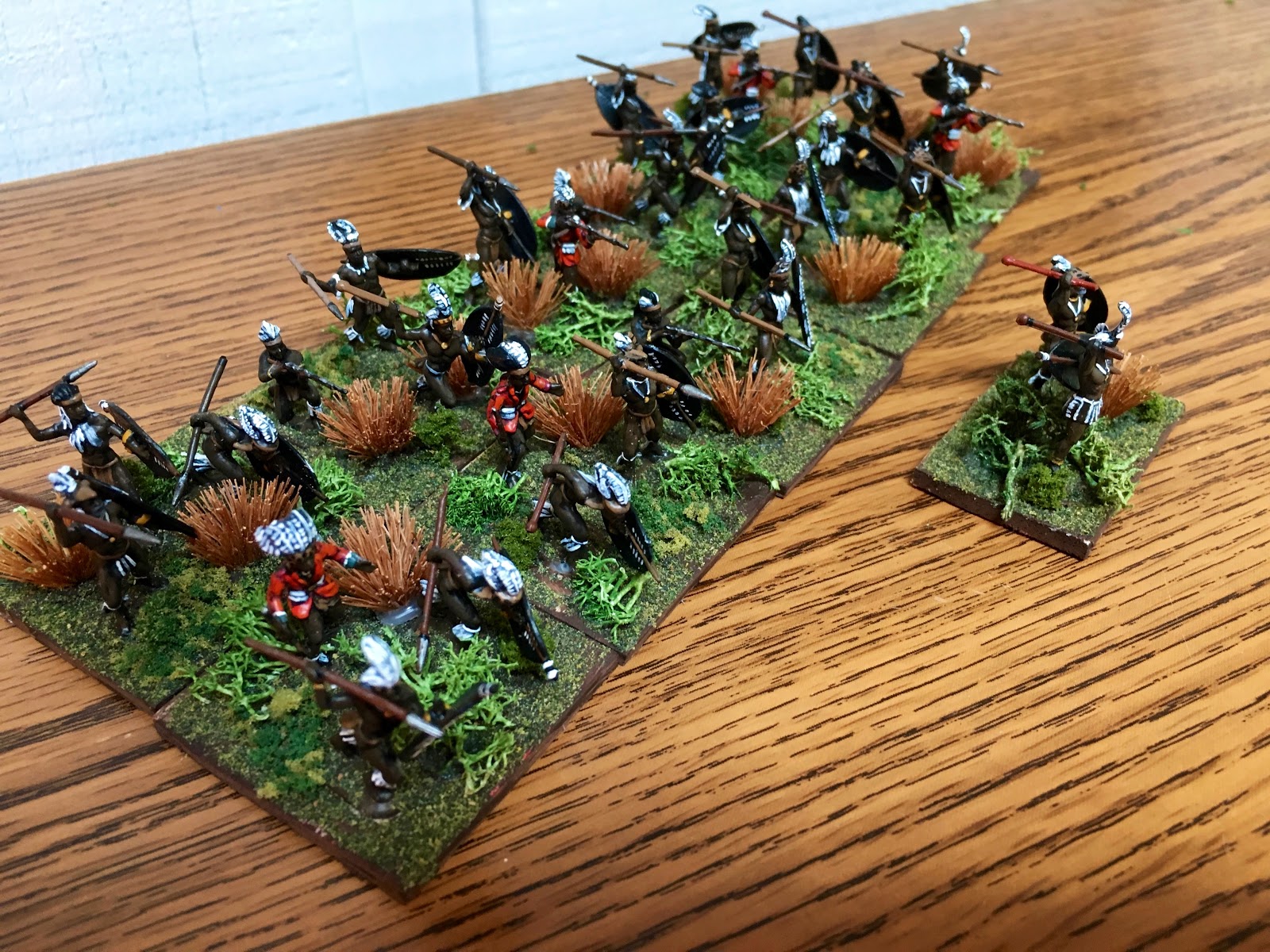
This is the start of my Zulu War Project I'm doing with a friend. For the most part we are using ESCI\Italeri and HAT plastics in 1\72 scale.

Although some are mounted on single stands the organization will be from Black Powder and the Zulu War Supplement. I also may make The Sword and the Flame work for smaller games that have a one-to-one feel to them.

The HAT British Mounted Infantry features enough poses for an 8 figure mounted unit as well as a 8 figure dismt unit.  I will use them interchangeably. 
Dismt and Mtd Contingents.
Mtd Contingent Skirmishing from the saddle
ESCI\Italeri Zulus...Excellent figures and a bit fancy! These are the umHlanga-The Reeds.
My organization will be 24-30 Zulus to a regiment plus a command unit.
inDunas out front end the um Hlanga to wash their spears!

Wednesday, June 22, 2016

Battle of St. Remy du Pleme 1432


THE BATTLE notes
The date of the battle was moved up a bit so that some of the knights were wearing outdated rather than anachronistic armor.  It was more important to recreate the game rather than document the progression of European armor styles year by year.
The battle was actually part of the Hundred Years War but was historically an inner French civil war between the King of France and the Armagnacs, a rebel faction.  A small affair by other battle's comparisons it weakened the Armagnacs and kept them at bay so that the English could gain all the glory at Agincourt.

RULE notes
The set used was the Cleveland Amendment version of the WRG late medieval rules.  The game flowed very well considering that the rules have been dormant for 30 years.  Somewhat complicated compared to the recent "quick learn" rule sets the era was recreated accurately by the dominance of the armored knight, as long as the field held no English longbowmen.  The army lists used were the WRG book three covering the early to late medieval/early renaissance periods.  The WRG system was used to field 1500 points for each army with most points obviously spent on armored cavalry.

ARMY notes
The book three lists allowed accurate representations of the two forces with well mounted knights on both sides along with lesser and mercenary cavalry filling the second ranks.  Militia and mercenary infantry were fielded and performed their role well, either holding their position or ridden down by the cavalry.  The small artillery park provided by the King accurately fired a few rounds and departed.  Italian mercenaries are abundant as the King had the money to spend.  The Swiss were aware of this fact and soon became the King's favorite employees.

Editor notes: Sadly, I (BR) lost the pic descriptions and am unfamiliar enough with the period (and was not at the game) to be able to identify the units and\or the game action. Nevertheless, the pictures are a feast for the eyes and worthy of a post. My apologies to my friend JZ who provided the scenario and figures. 

Peasants watch the knights collide


The abandoned artillery park after the news of Francois' demise.


Peasants cling to the Armagnac right. 

 The religious contingent lines up.


Wednesday, May 4, 2016

Oldies but Goodies: A Union Infantry Brigade in 22mm

Below are a number of pictures of Union ACW units that I painted about 30 years ago. Yeah, I'm that old.

The figures are 22mm Musket Miniatures (now out of business) but in 1984 they were called Stone Mountain Miniatures. Today a company named Stone Mountain makes similar miniatures but in the popular scale of 15mm.

A number of years after I painted these I got out of miniature wargaming for a number of reasons and sold off most of the thousands of metal miniatures I had painted and war-gamed with.

Although I have no memory of it one of my friends ended up with my ACW collection. I had roughly 4-5 regiments of USA and CSA and a couple of batteries. They were organized for a set of rules titled Rally Round the Flag.

In 2014 I reconnected with two of my old wargaming friends including the one who now owned my old collection. He had kept them in a box for roughly 20 years.

When we decided to war-game the ACW period again he dusted them off, remounted them and brought  them out for our first ACW battle in that scale in more than 20 years.

I was surprised how well they held up.

The added touch is that the flags are all hand painted by the other friend I reconnected with. I'm not sure he could do them now but he still is an excellent painter so who knows.

The brigade I painted was meant to model a brigade from the western Union armies. Each brigade had an attached artillery battery. A small unit of Union cavalry on the right rounded out my collection at the time (1984ish)
Close up of the firing line of the 26th Wisconsin. I had to paint at least one unit from my home state! Historically, I believe it was the 10th Wisconsin that was part of the brigade. Note the cavalry horse holder in the left background. Musket Miniatures was a very comprehensive line of 22mm figures. 
The 94th Ohio! I know that Union Regiments rarely carried a State flag so forgive the artistic license. 
The 33rd Ohio! Note the painted on Battle Honors. Onward Buckeyes!
Historically the 33rd Ohio saw a lot of action in some of major battles of the ACW.

Another view of the 33rd Ohio.
The majority of the units in this brigade were from the Buckeye State.
The Hoosier's of Indiana contributed the 38th to  the brigade. The Union Army frequently mixed units from the northern states into brigades while the Confederates after Antietam tried to maintain a State character to theirs.
In the meantime I'm painting new units of ACW. Most of the new units are plastic but I did manage to obtain a good number of Musket Miniatures before he went out of business in June of last year (2015)

Watch this space for the Texas Brigade ANV organized for Black Powder.